
 Written by
 Five reasons why I think student design challenges add value
In design, mastery doesn’t happen by watching – it happens by doing. That’s my experience – and I think that’s why student design competitions have become a firm fixture in education.
Mastery doesn’t happen by watching – it happens by doing.
I’m saying this as someone who has been on both sides of student design challenges – when I was an industrial design student I took part in competitions, and I’ve had the pleasure of organising (and judging) several.
They compress realworld constraints into a focused timeframe – teamwork, technical practice and creative problemsolving all come into play.
For students, that pressure sharpens skills and knowledge. For educators and employers, it’s a reliable signal of potential.
If you’ve ever trained for a race or prepared for a performance, you’ll be familiar with what’s involved: practice, iterate, test, refine.
A similar thing happens when students join a design challenge. They learn tools they’ll use in industry, they collaborate under pressure, and they push beyond what they thought they could do. And they do all these things together – as a team.
We’ve seen this again and again in our Designathon. Students develop their Autodesk Fusion knowledge and skills, build shared workflows, and respond to briefs with originality.
I know they add value – and I wanted to share my thoughts on why this is.
1. Challengebased learning sticks
Some of the best learning environments add just enough pressure to focus the mind – deadlines, criteria, and stakes which mean something (I know recognition and prizes motivate).
In a wellstructured competition, students have to move quickly from learning mode to active application of skills and knowledge. They interpret a brief, evaluate tradeoffs and options, and prototype under time constraints.
That shift from “knowing” to “doing” helps to cement longterm capability.
2. Constraints are creativity’s best friend
When I talk to my design peers, they’d agree with me in saying constraints free up your thinking. This is true in the Designathon. When teams have to balance feasibility, aesthetics and user needs – within hours, not weeks – ideas are refined, faster.
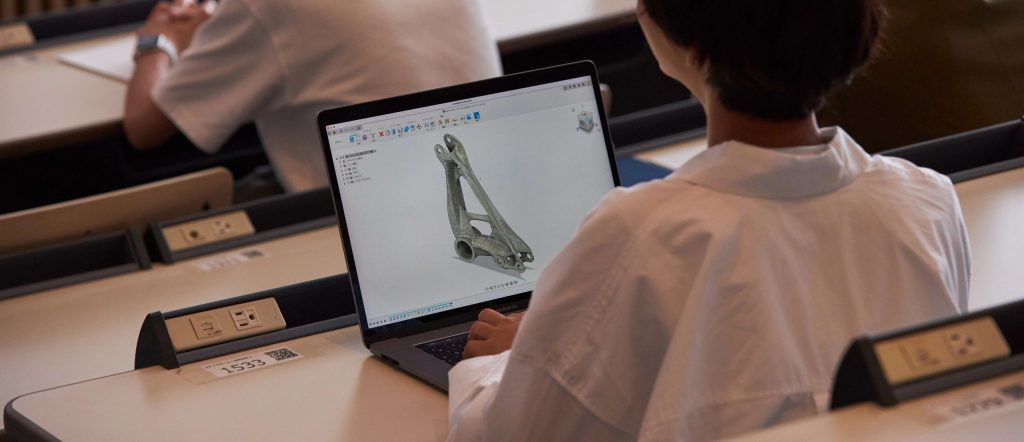
I recently looked back at some of winning concepts from previous editions of the Designathon.
In 2024, one team’s “mobile machine” explored resilience and renewable energy through solar panels, tempered glazing and AIassisted monitoring – they demonstrated systems thinking under constraint.
Another team designed a compact hydroponics system powered by solar, integrating sensors for pH and nutrient control – a lesson in designing for performance, portability and efficiency.
3. Real tools, real world learning
In a competition (and in the preparation for it), students don’t just learn about tools – they learn how to use them with purpose.
Working in Autodesk Fusion against a live brief mirrors what’ll they’ll encounter in design studios and startups: versioning, collaboration, and quick iteration toward a deliverable.
That practical fluency is precisely what employers look for – and I believe it helps to smooth the classroom-towork transition.
4. Collaboration fuels confidence
Competitions are communities with a countdown clock! They provide a space where peers share tactics, identify strengths and weaknesses, and celebrate progress.
I know first-hand how competitions encourage innovative thinking, provide a platform to experiment, and act as proof of expertise for future opportunities. We encourage students taking part in our Designathon to share their designs with the community on the Autodesk gallery and through their social channels.
The confidence the students gain from is as valuable as any certificate.
5. A global perspective, from day one
Design is global. When students join a challenge which attracts participants from dozens of institutions and countries, the learning multiplies.
They see a range of approaches and design for varied contexts, alongside technical skills.
Last year was a case in point. The challenge set was to use Autodesk Fusion to design and model an outdoor space for students to collaborate, learn and socialise.
With entries from northern Europe to southern Africa, climatic and environmental factors provided context and inspired a range of ideas.
When I looked back through comments from students who took part in Designathon 2025 – they celebrated the ideas, and acknowledged their peers’ skills.
What effect do these things have? Broader thinking and stronger ideas – and a determination to learn more.
Coming soon
For us at KnowledgePoint, international student competitions are firmly embedded in our annual programme.
We run them because we believe they offer highimpact test environments for the skills that matter for those pursuing careers in industrial design – creative resilience, systems thinking, tool fluency and collaboration.
And for those students looking out for Designathon 2026, watch this space.
About the author
Furkan Günal is a partner recruitment executive at KnowledgePoint and Autodesk Expert Elite.
He’s a member of the organising team for the annual Designathon, during which we benefit from his experience with and knowledge of Autodesk Fusion.
Prior to joining KnowledgePoint, he was an Industrial Design Engineering student at Gazi University, gaining credentials in Design and 3D Modeling.